JCATI Impact

Since 2013, the Joint Center for Aerospace Technology Innovation (JCATI) has invested more than $19.6 million in 219 industry–university projects, partnering 112 aerospace companies in 18 Washington counties with engineering faculty and students at the state's public universities. These collaborations help companies solve technology roadblocks, from composites and advanced manufacturing to propulsion, space systems, and sustainable aviation, while training the next generation of Washington's aerospace workforce.

The stories below show what happens when industry challenges meet university expertise. Interested in partnering? Learn about JCATI funding opportunities or submit an industry partner inquiry.

The power of plasma

UW Mechanical Engineering researchers and Mukilteo-based Electroimpact are testing whether plasma treatment during automated fiber placement can produce stronger aerospace composites, in a JCATI-funded project at the UW Advanced Composites Center.
Read More

JCATI partnership propels space startup to historic launch

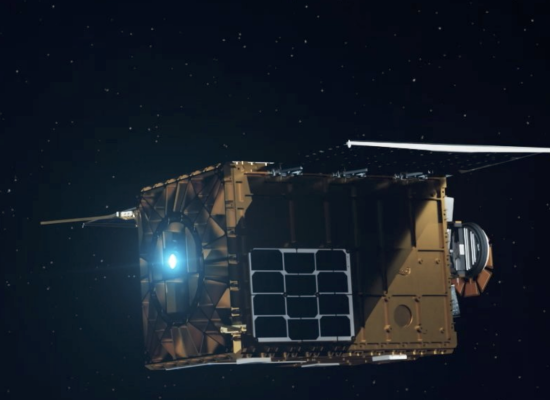
Juno Propulsion and UW's Detonation Engines Lab teamed up through JCATI to ready the first rotating detonation engine for an orbital flight.
Read More

Robotics for manufacturing

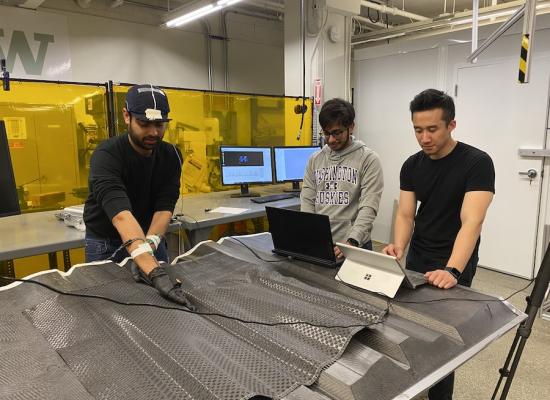
In a project jointly funded by Boeing and JCATI, UW Mechanical Engineering researchers Krithika Manohar and Ashis Banerjee are using head-mounted cameras and pressure-sensing gloves to quantify ergonomic injury risk for technicians who lay up composites by hand.
Read More

Tugs in space

Seattle-based Starfish Space teamed with UW's Autonomous Controls Lab, led by Professor Behçet Açikmeşe, to advance guidance and control for satellite-servicing “space tugs.” Starfish co-founder Trevor Bennett credits JCATI with bridging the gap between early-stage research and commercial technology.
Read More

JCATI-Toray Research Team

Funded by a JCATI award, Western Washington University and Toray Composites America are investigating chemical recycling methods for scrap carbon fiber composites, with students studying how recycling conditions affect recovered fiber and resin properties.
Read More

Researchers develop recyclable composites

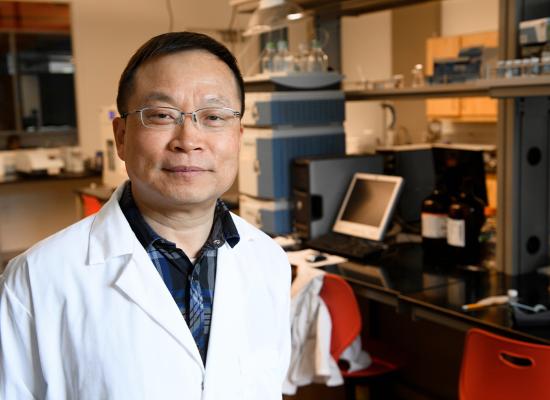
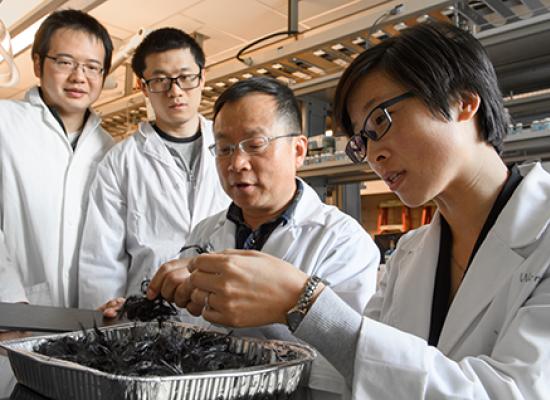
WSU researchers led by Jinwen Zhang developed a recyclable carbon fiber composite, with support from the Department of Energy and JCATI.
Read More

Researchers use origami to solve space travel challenge

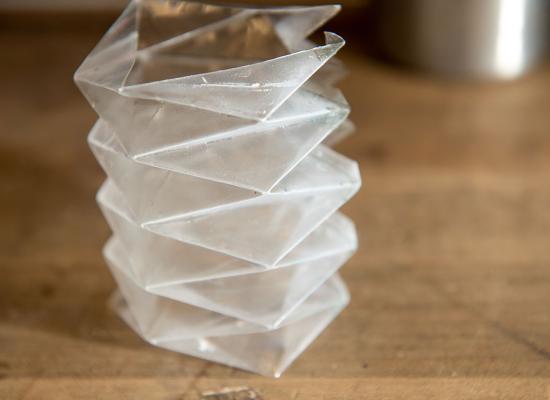
WSU's hydrogen lab and Blue Origin used origami-inspired design to build a fuel bladder that won't crack at super-cold temperatures.
Read More

New biojet fuel could be a viable alternative to fossil fuel

A WSU Tri-Cities team used a $100,000 JCATI grant to test lignin-derived hydrocarbons as a cleaner, higher-performing jet fuel component.
Read More

Researchers develop recycling for carbon fiber composites

WSU and Global Fiberglass Solutions developed a JCATI-funded chemical process that recovers carbon fiber from composite waste.
Read More

Grant funds test of market potential for jet fuel research

An NSF I-Corps grant let Bin Yang's WSU Tri-Cities team test the market for lignin-based jet fuel, research JCATI helped build.
Read More

Collaboration Spotlight: Partnering for Aerospace

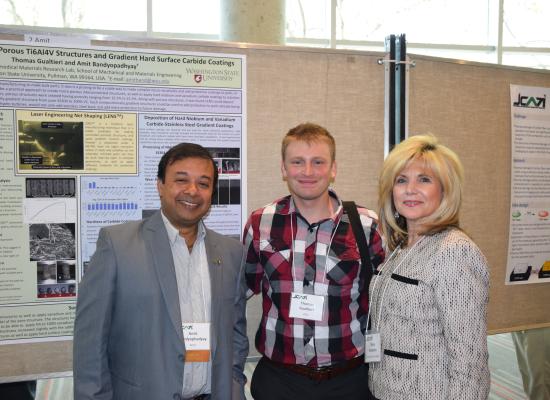
JCATI connected WSU additive manufacturing researchers with Aerojet Rocketdyne to find more efficient ways to make satellite parts.
Read More

Collaboration through JCATI

UW A&A's Highflight newsletter profiled eight JCATI-funded projects with partners including Insitu, Aerojet Rocketdyne and Boeing, from coordinating multiple unmanned aircraft to an early rotating detonation engine study.
Read More

Partnership boosts state aerospace industry

WSU's Applied Sciences Laboratory and Triumph Composite Systems worked on more corrosion-resistant thermoplastic aircraft parts.
Read More